Table of Contents
Problem
Starting with the number $1$ and moving to the right in a clockwise direction a $5$ by $5$ spiral is formed as follows:
21 22 23 24 25
20  7  8  9 10
19  6  1  2 11
18  5  4  3 12
17 16 15 14 13
It can be verified that the sum of the numbers on the diagonals is $101$. What is the sum of the numbers on the diagonals in a $1001$ by $1001$ spiral formed in the same way?
Is there a pattern?
The spiral starts at $1$ and then the diagonals zoom off in four directions. Let's ignore $1$ for now and just focus on the corners of the diagonals. What can we tell about the first four corners? We have $3\ ,5\ ,7\ and\ 9$ and there's a gap, or difference, of $2$ between them.
The next four corners after that are $13,\ 17\ ,21\ and 25.$ with a difference of $4.$ Actually, from $1\ to\ 3$ there is a difference of $2$ and from $9$ to $13$ there is a difference of $4.$
The question then becomes, is the difference between corners going to grow by $2$ at each level?
It seems promising because we can also pretend that $1$ is its own four corners, a difference of $0$ between them.
Let's see if this correctly predicts the next set of corners.
We should expect the next level of corners to come from a difference of $6$ and the level after that by $8$.
Prediction
$$ Starts\ at\ 1 $$ $$ Corners\ by\ +2:\quad \quad 03\quad 05\quad 07\quad 09 $$ $$ Corners\ by\ +4:\quad \quad 13\quad 17\quad 21\quad 25 $$ $$ Prediction: $$ $$ Corners\ by\ +6:\quad \quad 31\quad 37\quad 43\quad 49 $$ $$ Corners\ by\ +8:\quad \quad 57\quad 65\quad 73\quad 81 $$
It's promising that all the final numbers are square numbers. It seems like a pattern that would fall out of a thing like this.
Sketchy prediction
Let's sketch this out on paper. Do the predicted numbers fall on the diagonals?
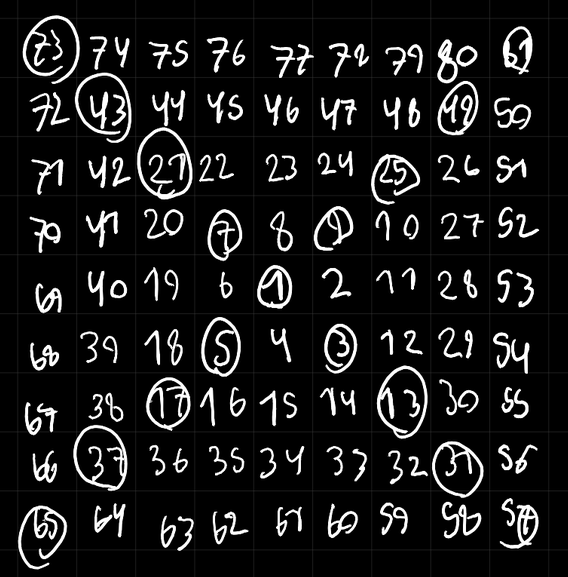
Yes! We do indeed get $31,\ 37,\ 43,\ 49,\ 57,\ 65,\ 73,\ and\ 81$ next. I'll forgive you if you can't make that out from my awful handwriting.
Now, interestingly, a difference of $8$ is between the corners of the $9\times 9$ spiral. A difference of $6$ between the corners of the $7\times 7$ spiral.
This tells us that we need to consider differences up to $1000$, for the corners of the $1001\times 1001$ spiral; the problem's target.
Towards a solution
It would make sense to create an array of differences that looks like this:
[1 2 2 2 2 4 4 4 4 6 6 6 6 8 8 8 8 ...]We'd only have to scan add it, to generate the corners and then finally
reduce add it to get the sum.
# Wowee, the corners
    \+ [1 2 2 2 2 4 4 4 4 6 6 6 6 8 8 8 8]
[1 3 5 7 9 13 17 21 25 31 37 43 49 57 65 73 81]

# Their sums
    /+ \+ [1 2 2 2 2 4 4 4 4 6 6 6 6 8 8 8 8]
537
The keep trick
The repeats of $4$ differences is easy to do once you know this one trick that doctors hate.
    ▽ 1 1_2_3
[1 2 3]
    ▽ 2 1_2_3
[1 1 2 2 3 3]
    ▽ 3 1_2_3
[1 1 1 2 2 2 3 3 3]
That's right. You can repeat every single element of an array, by a set amount,
using keep repeat_amount array. In the words of the docs itself:
▽ keep with a scalar for the first argument repeats each row of the second argument that many times.
Getting the differences themselves
There are various ways to get a range [2 4 6 8 ... 998 1000].
If you look at the ranges tutorial you might come away with this.
    ⍜÷⇡₁2 1000
[2 4 6 8 ... 998 1000]
You might also use mod 2 in combination with not.
    ▽¬⊸◿2⇡₂1000
[2 4 6 8 ... 998 1000]
Or simply multiply a range of $1-500$ by $2.$
    ×₂⇡₁500
[2 4 6 8 ... 998 1000]
I'll go with that one.
Solution
We start with our range of singular differences.
    ×₂ ⇡₁500
[2 4 6 8 ... 998 1000]
We keep four instances of each difference.
    ▽4 ×₂ ⇡₁500
[2 2 2 2 4 4 4 4 ... 1000 1000 1000 1000]
Since our initial corner is $1$, we need to join it to the array.
    ⊂1 ▽4 ×₂ ⇡₁500
[1 2 2 2 2 4 4 4 4 ... 1000 1000 1000 1000]
Now, to scan add for the corners.
    \+ ⊂1 ▽4 ×₂ ⇡₁500
[1 3 5 7 9 13 17 21 25 31 ... 1000001 1001001 1002001]
Finally, we reduce add for the sum.
    /+ \+ ⊂1 ▽4 ×₂ ⇡₁500
669171001
Fast?
Ye.
    ⊙◌⍜now(/+ \+ ⊂1 ▽4 ×₂ ⇡₁500)
0.00009202957153320313